
Specifications and workshop reference information for the 1975 Honda MR175, including engine, chassis, service data and setup details.
Note: Specs are compiled from factory data, manuals and owner feedback. Bikes vary — if yours is different, jump into the forum and share it.
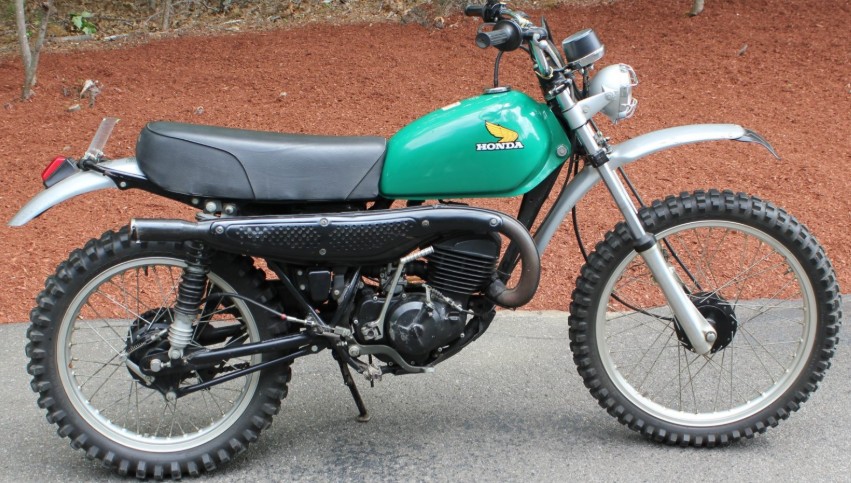
| Manufacturer | Honda |
| Model | MR175K0 |
| Year | 1975 |
| Motorcycle Type | Enduro / off-road |
| Engine Capacity | 171 cc |
| Dry Weight | 92.5 kg |
| Overall Length | 2055 mm |
| Overall Width | 890 mm |
| Overall Height | 1125 mm |
| Wheelbase | 1365 mm |
| Ground Clearance | 250 mm |
| Fuel Capacity | 11.0 litres |
| Fuel Reserve | 2.7 litres |
| Engine Type | Air-cooled single-cylinder two-stroke |
| Cylinder Arrangement | Single cylinder, inclined 15° from vertical |
| Bore | 66.0 mm |
| Stroke | 50.0 mm |
| Displacement | 171 cc |
| Compression Ratio | 6.8:1 |
| Starting System | Kick starter |
| Lubrication | Premix fuel/oil lubrication | Premix Calculator |
| Carburetor | 28 mm Keihin | Replacement Options |
| Main Jet | #125 |
| Air Cleaner | Oil-wetted foam element |
| Clutch | Wet multi-plate |
| Transmission | 5-speed constant mesh |
| Primary Reduction Ratio | 3.000:1 |
| 1st Gear Ratio | 1.875:1 |
| 4th Gear Ratio | 0.958:1 |
| 5th Gear Ratio | 0.741:1 |
| Final Reduction Ratio | 2.866:1 |
| Final Drive | Chain |
| Frame Type | Semi-double cradle |
| Front Suspension | Telescopic fork | Fork Oil Levels |
| Front Fork Oil Capacity | 160 cc per fork leg when filling a dry assembly |
| Rear Suspension | Swingarm with twin shock absorbers | Rear Suspension Setup |
| Front Brake | Internal expanding drum brake |
| Rear Brake | Internal expanding drum brake |
| Brake Drum Diameter | 110 mm front and rear |
| Front Tyre | 3.00-21 4PR | Tyre Size Guide |
| Rear Tyre | 3.50-18 4PR | Tyre Size Guide |
| Front Tyre Pressure | 14.2 psi (1.0 kg/cm²) |
| Rear Tyre Pressure | 14.2 psi (1.0 kg/cm²) |
| Ignition | Flywheel magneto |
| Generator | AC generator |
| Spark Plug | NGK B8ES |
| Spark Plug Gap | 0.6-0.7 mm |
| Ignition Timing | 20.5° BTDC |
The 1975 Honda MR175 occupies an interesting place in Honda’s off-road history. During the mid-1970s, Honda was already well known for its four-stroke trail bikes and increasingly serious CR motocross machines. The MR range sat between those worlds, giving riders a purpose-built two-stroke enduro that was more trail-friendly than a CR but considerably more competition-oriented than the typical road-legal XL.
At its heart was a 171 cc air-cooled single-cylinder two-stroke engine. It was deliberately tuned for usable off-road power rather than the harder-hitting delivery expected from a motocrosser. That made the MR175 well suited to tight trails, enduros and long days in the bush where controllability and reliability could matter more than outright horsepower.
Fuel was delivered through a 28 mm Keihin carburettor. On a surviving MR175, carburetion deserves careful attention because decades of wear, previous modifications and incorrect jetting can substantially change how the engine behaves. Owners rebuilding an original unit can use the vintage motorcycle carburettor replacement guide when researching suitable components and alternatives.
Unlike Honda’s four-stroke trail machines, the MR175 relied on premixed petrol and two-stroke oil. Getting the mixture correct remains important, particularly with a restored engine or a bike being returned to regular riding after years in storage. The two-stroke premix ratio calculator provides a quick way of calculating oil quantities when mixing fuel.
A five-speed transmission transferred power through a conventional chain final drive. The gearing complemented the MR’s enduro role, where riders needed useful low-speed control without sacrificing the ability to cover faster open sections. Today, owners should inspect both sprockets as a pair rather than simply fitting a new chain to worn originals. The vintage motorcycle chains and sprockets guide is useful when assessing replacement options.
The chassis followed proven mid-1970s practice with telescopic front forks and a swingarm controlled by twin rear shock absorbers. Suspension technology was advancing rapidly during this period, but the MR175 still belonged firmly to the twin-shock era. Correct fork servicing can transform the feel of a neglected example, particularly where old oil, hardened seals or internal corrosion have affected damping. VMX owners tackling the front end can refer to the vintage motorcycle fork oil reference.
Drum brakes front and rear, wire-spoked wheels and generous ground clearance completed a straightforward package designed to survive genuine off-road use. The lack of complicated technology is also a major advantage for restorers today.
The MR175 never achieved the legendary status of Honda’s CR motocross models, and that is partly what makes it interesting. It represents Honda experimenting seriously with lightweight two-stroke enduro machinery during one of the fastest-changing periods in off-road motorcycle development.
For vintage riders, a properly sorted MR175 offers something different from the more familiar Honda four-strokes: light weight, simple mechanicals, unmistakable 1970s styling and a two-stroke engine designed for the trails rather than the motocross start gate.
Discuss motocross bikes, restorations, tuning and riding.