
Specifications and workshop reference information for the 1973 Honda XL175, including engine, chassis, service data and setup details.
Note: Specs are compiled from factory data, manuals and owner feedback. Bikes vary — if yours is different, jump into the forum and share it.
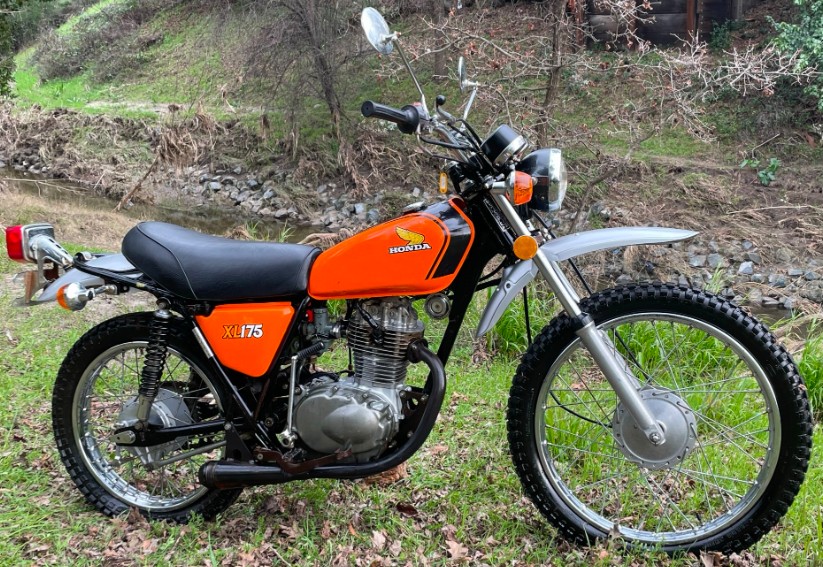
| Manufacturer | Honda |
| Model | XL175 K0 |
| Year | 1973 |
| Motorcycle Type | Dual-purpose / trail motorcycle |
| Country of Origin | Japan |
| Engine Capacity | 173 cc |
| Dry Weight | 108 kg |
| Overall Length | 2075 mm |
| Overall Width | 840 mm |
| Overall Height | 1095 mm |
| Engine Type | Air-cooled single-cylinder four-stroke |
| Valve Train | SOHC |
| Cooling | Air cooled |
| Starting System | Kick starter |
| Exhaust | Single downswept exhaust |
| Carburetor | Single carburetor | Replacement Options |
| Fuel Type | Petrol |
| Transmission | 5-speed manual |
| Final Drive | Chain |
| Drive Chain Size | 520 |
| Front Suspension | Telescopic fork | Fork Oil Levels |
| Rear Suspension | Twin shock absorbers | Rear Suspension Setup |
| Front Brake | Drum |
| Rear Brake | Drum |
| Wheel Type | Wire-spoke |
| Front Tyre | 2.75-21 | Tyre Size Guide |
| Rear Tyre | 3.50-18 | Tyre Size Guide |
| Ignition | Battery-powered DC ignition |
| Battery | Yuasa 6N6-3B |
| Spark Plug | NGK B7ES |
The 1973 Honda XL175 arrived at a time when lightweight trail motorcycles were becoming serious all-round machines. Riders wanted something capable of handling weekday road use, weekend trail riding and the occasional club event without the temperament of a competition two-stroke. Honda’s answer was a simple, dependable four-stroke single that today makes an interesting and very usable vintage restoration.
At the heart of the XL175 was Honda’s 173 cc air-cooled, single-cylinder four-stroke engine. Rather than chasing outright horsepower, Honda concentrated on tractable power and reliability. The single overhead cam engine delivered the sort of predictable low and mid-range response that worked particularly well on trails, fire roads and tighter going.
Fuel was supplied through a conventional single carburettor. Decades later, this is naturally one of the areas owners need to inspect carefully. Worn jets, incorrect float settings, blocked passages and intake leaks can turn an otherwise healthy old Honda into a frustrating starter. Owners rebuilding the original unit or looking at alternatives can compare information in the vintage motorcycle carburettor replacement guide.
Power went through a five-speed gearbox and chain final drive. The uncomplicated layout is one of the XL175’s attractions as a vintage project, although age means the final drive deserves more attention than it might first appear. Hooked sprocket teeth, stiff chain links and incorrect gearing are common discoveries on motorcycles that have passed through numerous owners. The VMXOwners motorcycle chains and sprockets reference is useful when bringing this area back into service.
Chassis design was equally straightforward. Conventional telescopic forks handled the front while twin shock absorbers controlled the rear. By modern standards the suspension travel and damping are modest, but that is part of riding a motorcycle from this period. Correct servicing makes a substantial difference, particularly if an XL175 has spent years sitting unused. Fresh seals, straight fork tubes and the correct quantity of fork oil should be addressed before trying to compensate for poor handling elsewhere. The vintage motorcycle fork oil reference can help owners working through front suspension servicing.
Drum brakes were fitted front and rear, while the large 21-inch front wheel and 18-inch rear reflected the XL’s trail intentions. Original-style tyre sizing also differs from the modern metric markings many riders are accustomed to, making the vintage motorcycle tyre size guide useful when selecting replacements.
For restorers, the appeal of the 1973 XL175 is its simplicity. There are no radiators, power valves, electronic engine-management systems or complicated suspension linkages. Instead, the important work involves fundamentals: compression, valve clearances, ignition condition, carburetion, wheel bearings, brakes, steering-head bearings and suspension.
The XL175 was never intended to be Honda’s ultimate motocross weapon. Its importance lies elsewhere. It represents the early-1970s period when Honda was refining the lightweight four-stroke trail motorcycle into a dependable machine that ordinary riders could use almost anywhere. More than half a century later, that same uncomplicated character is exactly what makes a well-sorted XL175 enjoyable to own and ride.
Discuss motocross bikes, restorations, tuning and riding.