
Specifications and workshop reference information for the 1985 ATK560, including engine, chassis, service data and setup details.
Note: Specs are compiled from factory data, manuals and owner feedback. Bikes vary — if yours is different, jump into the forum and share it.
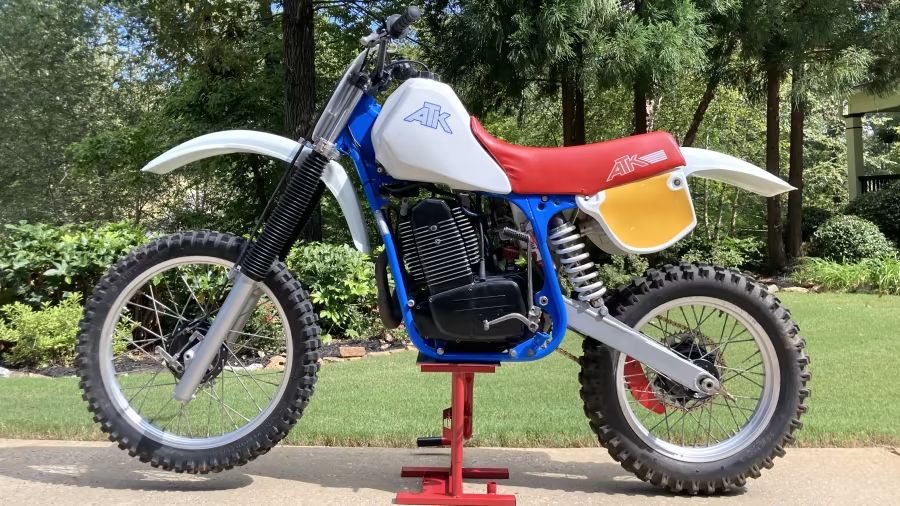
| Engine Type | Rotax 4-stroke |
| Displacement | 562 cc |
| Bore × Stroke | 94 mm × 81 mm |
| Compression Ratio | 9.8:1 |
| Maximum Power | 51 hp @ 9500 rpm (open exhaust, 860 cam) |
| Maximum Torque | 34.0 lb-ft (around 46 Nm) |
| Carburetor | Mikuni 38 mm flat slide | Replacement Options |
| Lubrication | Dry sump system with main stream oil filter |
| Fuel Mix Ratio | N/A (4-stroke) | Premix Calculator |
| Ignition | CDI electric advancing system |
| Spark Plug | Champion N6YC / NGK D8EA |
| Spark Plug Gap | 0.6 mm to 0.7 mm (approximately 0.024 in) |
| Transmission Type | 5-speed |
| Primary Reduction | 76/32 (2.375) |
| Final Reduction | 15T / 48T |
| Overall Length | 84 inches (2133 mm) |
| Overall Width | 37.8 inches (960 mm) |
| Overall Height | 1,270 mm (50.0 inches) |
| Wheelbase | 1473 mm (58 in) |
| Ground Clearance | 343 mm (13.5 in) |
| Fuel Tank Capacity | 3.3 gal |
| Bearing Sizes | Bearing Finder |
| Frame Type | Double downtube chrome moly frame with integrated oil tank |
| Front Suspension | White Power upside-down forks with Brembo disc brake | Fork Oil Levels |
| Rear Suspension | White Power single shock with adjustable compression and rebound damping |
| Front Suspension Travel | 300 mm (11.8 in) |
| Rear Suspension Travel | 330 mm (13.0 in) |
| Front Tire | 80/100-21 |
| Rear Tire | 110/100-18 |
| Front Brake | Brembo disc |
| Rear Brake | disc |
The 1985 ATK 560 came from a very different school of motorcycle design. At a time when the Japanese manufacturers dominated off-road competition, ATK was building distinctive American motorcycles around European engines and components. The company was founded by Austrian-born engineer Horst Leitner, whose ideas about reducing weight, improving suspension behaviour and simplifying maintenance gave ATK machines an identity unlike almost anything else on the starting line.
Power came from a large air-cooled Rotax four-stroke single. With around 562 cc available, the ATK was not short of torque, but its appeal was about more than outright engine capacity. Leitner wanted a big four-stroke that didn't feel unnecessarily heavy, and the resulting machine combined serious power with a relatively minimalist chassis. For riders used to conventional Japanese enduro bikes, the ATK could look almost hand-built by comparison.
Fuel delivery came through a 38 mm Mikuni flat-slide carburettor. On a surviving ATK 560, carburettor condition is particularly important. Hardened seals, worn jets, incorrect float height or modifications made by previous owners can dramatically change starting and low-speed behaviour. Before chasing ignition or internal engine problems, establishing a known-good carburettor setup is worthwhile.
The chassis was equally interesting. ATK used a chrome-moly frame, while White Power suspension components reflected the European influence behind the motorcycle. The long-travel upside-down front end was sophisticated equipment for the period, and owners recommissioning one today should treat the White Power fork components and seals as an important part of the restoration rather than simply concentrating on the engine.
At the rear, the ATK's suspension philosophy helped distinguish the bike from mainstream Japanese designs. Correct spring condition, damping and linkage or mounting condition remain critical on a motorcycle approaching forty years old. A properly serviced White Power rear suspension system can make the difference between experiencing the handling its designers intended and wrestling with a tired old dirt bike.
The 560's big four-stroke torque also makes the final drive worth inspecting carefully. Old sprockets and stretched chains can disguise themselves as poor throttle response or rough power delivery. Checking the chain and sprocket gearing is especially worthwhile if a previous owner altered ratios for desert, enduro or trail riding.
What makes the 1985 ATK 560 particularly fascinating today is its place in four-stroke history. During an era remembered largely for increasingly powerful and sophisticated two-stroke motocross machines, ATK demonstrated that a large four-stroke could be made into a serious performance motorcycle without simply accepting excessive weight.
Surviving examples are also considerably less common than contemporary Hondas, Yamahas or Kawasakis, making originality and correct period components increasingly important. Rotax engine parts can still be familiar to specialists, but ATK-specific chassis pieces, bodywork and fittings may require patience to locate.
The 1985 ATK 560 was never a mass-market motorcycle, and that is precisely why it remains so interesting. It represents an independent engineer's answer to the question of what a big-bore four-stroke dirt bike should be — powerful, lightweight, unconventional and unmistakably ATK.
Discuss vintage motocross bikes, restorations, tuning and riding.