
Specifications and workshop reference information for the 1981 Honda CR250, including engine, chassis, service data and setup details.
Note: Specs are compiled from factory data, manuals and owner feedback. Bikes vary — if yours is different, jump into the forum and share it.
| Engine Type | Liquid-cooled 2-stroke single-cylinder reed valve |
| Displacement | 248 cc |
| Bore × Stroke | 70.0 mm × 64.4 mm |
| Compression Ratio | 8.0:1 |
| Maximum Power | Approx. 39 hp |
| Maximum Torque | |
| Carburetor | Keihin PE36 | Replacement Options |
| Lubrication | Pre-mix |
| Fuel Mix Ratio | 20:1 | Premix Calculator |
| Ignition | CDI magneto |
| Spark Plug | NGK BR8ES |
| Spark Plug Gap | 0.6 - 0.7 mm |
| Transmission Type | 5-speed close-ratio |
| Clutch | Wet multi-plate |
| Primary Reduction | 3.000 |
| Final Reduction | Chain drive |
| Overall Length | 86.4 in |
| Overall Width | 36.2 in |
| Overall Height | 48.0 in |
| Wheelbase | 58.7 in |
| Ground Clearance | 13.4 in |
| Fuel Tank Capacity | 2.4 gal |
| Bearing Sizes | Bearing Finder |
| Frame Type | Double cradle steel frame |
| Caster Angle | 28° |
| Trail | 4.8 in |
| Front Suspension | Showa leading-axle forks | Fork Oil Levels |
| Rear Suspension | Pro-Link monoshock |
| Front Suspension Travel | 11.8 in |
| Rear Suspension Travel | 11.4 in |
| Front Tire | 3.00 × 21 | Tyre Size Guide |
| Rear Tire | 4.50 × 18 | Tyre Size Guide |
| Front Brake | Single leading shoe drum |
| Rear Brake | Single leading shoe drum |
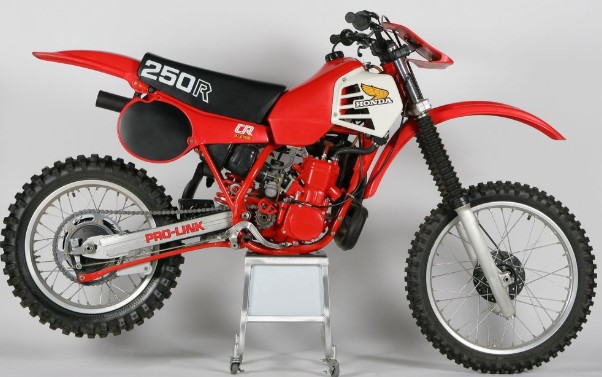
The 1981 Honda CR250R was far more than another yearly update to Honda’s Elsinore line. It represented a dramatic change in direction and arrived during one of the fastest periods of technical development motocross had ever seen. Water cooling, rising-rate rear suspension and increasingly specialised chassis design were beginning to replace technology that had defined motocross throughout the 1970s.
At the centre of the 1981 CR250R was Honda’s liquid-cooled 249cc two-stroke engine. The move away from air cooling was significant. Motocross engines were producing increasing amounts of power, and controlling cylinder temperature during a hard race was becoming increasingly important. Liquid cooling helped provide more consistent operating temperatures and allowed engineers greater freedom when developing engine performance.
Fuel delivery remained conventional, with a Keihin carburettor feeding the two-stroke engine. For owners running one today, careful setup of the Keihin carburettor and jetting remains important. Age, modern fuels, exhaust changes and engine modifications can all mean that settings which worked decades ago are not necessarily ideal for a restored or regularly raced machine.
The other major development was at the rear of the motorcycle. Honda introduced its Pro-Link rising-rate single-shock suspension, abandoning the twin-shock layout that had characterised earlier CR250s. The system used linkage geometry to progressively alter the effective suspension rate as the rear wheel moved through its travel. It was a major step toward the basic rear suspension arrangement that would eventually become standard motocross practice.
More than four decades later, however, that linkage deserves careful inspection. Wear in bearings, bushes and pivots can dramatically affect ride height and suspension action. Properly rebuilding and setting up the Pro-Link rear suspension system can transform the feel of a tired survivor.
Honda was also experimenting aggressively with chassis design. The 1981 CR250R is instantly recognisable for its unusual appearance, particularly the relationship between the fuel tank, frame and cooling system. Honda was searching for better weight distribution while packaging technology that simply had not existed on previous generations of motocross bikes.
The front suspension was equally important to the overall package. On a bike now more than forty years old, deteriorated seals, contaminated oil and worn internal components can make the forks perform nothing like they did when new. Checking the front forks, seals and suspension components should therefore be high on the list for anyone preparing an original 1981 CR250R for vintage competition.
Owners should also remember that these motorcycles were built to race, and many surviving examples have lived hard lives. Engines may have been rebuilt repeatedly, frames repaired, suspension modified and original parts replaced with whatever was available at the time. Before beginning an expensive restoration, identifying exactly what remains original can save considerable frustration when hunting for missing components through a vintage motocross parts search.
The 1981 CR250R was not simply important because of race results or outright performance. Its significance lies in what Honda was attempting to do.
In one model, Honda combined liquid cooling, Pro-Link suspension and a new generation of motocross chassis thinking. Some ideas would be refined rapidly over the following seasons, but the direction was clear.
The 1981 CR250R was Honda stepping decisively out of the 1970s and into the modern motocross era.
Discuss vintage motocross bikes, restorations, tuning and riding.