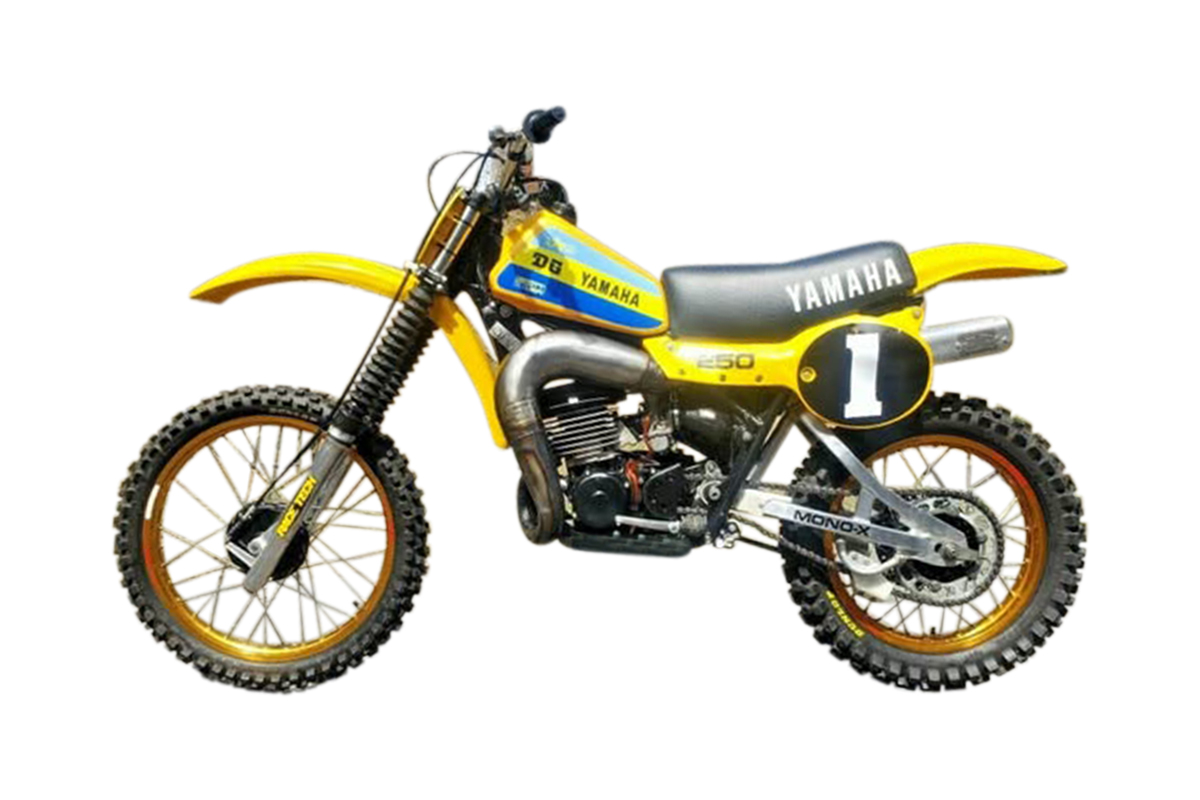
Specifications and workshop reference information for the 1979 Yamaha YZ250, including engine, chassis, service data and setup details.
Note: Specs are compiled from factory data, manuals and owner feedback. Bikes vary — if yours is different, jump into the forum and share it.
| Engine Type | Air-cooled 2-stroke single-cylinder reed valve |
| Displacement | 246 cc |
| Bore × Stroke | 70.0 × 64.0 mm |
| Compression Ratio | 6.8:1 |
| Maximum Power | |
| Maximum Torque | |
| Carburetor | Mikuni VM38SS | Replacement Options |
| Lubrication | Premix |
| Fuel Mix Ratio | 20:1 | Premix Calculator |
| Ignition | CDI Magneto |
| Spark Plug | NGK B8ES |
| Spark Plug Gap | 0.6 - 0.7 mm |
| Transmission Type | 5-speed constant mesh |
| Clutch | Wet multi-plate |
| Primary Reduction | 3.000 |
| Final Reduction | Chain drive |
| Overall Length | 2170 mm |
| Overall Width | 820 mm |
| Overall Height | 1240 mm |
| Wheelbase | 1490 mm |
| Ground Clearance | 300 mm |
| Fuel Tank Capacity | 10.0 L |
| Bearing Sizes | Bearing Finder |
| Frame Type | Steel single backbone |
| Caster Angle | 28° |
| Front Suspension | Telescopic forks | Fork Oil Levels |
| Rear Suspension | Monocross single shock |
| Front Suspension Travel | 280 mm |
| Rear Suspension Travel | 295 mm |
| Front Tire | 3.00-21 | Tyre Size Guide |
| Rear Tire | 4.50-18 | Tyre Size Guide |
| Front Brake | Drum |
| Rear Brake | Drum |
By 1979, Yamaha’s YZ250 had developed into a serious motocross weapon. The revolutionary Monoshock concept was no longer simply an unusual Yamaha feature; it had become an established part of the company’s racing identity. The 1979 YZ250 arrived during an intensely competitive period when Japanese manufacturers were rapidly improving suspension travel, engine performance and chassis design from one season to the next.
At the heart of the YZ250 was Yamaha’s air-cooled 246 cc two-stroke single. Like most serious motocross machines of the period, performance depended heavily on correct carburettor setup, ignition condition and fuel mixture. Owners restoring or recommissioning one today should resist the temptation to assume that whatever jets are currently fitted are original. Decades of racing, modifications and changing fuels mean many surviving machines have been altered. The VMXOwners carburettor reference and replacement guide can be useful when identifying what is fitted and considering replacement options.
The chassis is where the late-1970s YZ story becomes particularly interesting. Yamaha had introduced its Monoshock rear suspension earlier in the decade, placing a single shock beneath the fuel tank and seat rather than using the conventional pair of rear shocks. By 1979 the system had been refined considerably, while Yamaha's competitors were still developing their own answers to the rapidly escalating suspension-travel race.
For a modern owner, getting that old suspension working properly is just as important as rebuilding the engine. A freshly restored motor combined with tired suspension can make a vintage motocrosser surprisingly unpleasant to ride. Worn bushes, incorrect damping, tired springs and decades-old oil can transform the handling. VMXOwners' rear suspension reference provides a useful starting point when assessing the rear end of a surviving machine.
The conventional telescopic front forks also deserve attention. Fork tubes should be inspected carefully for corrosion and pitting, particularly around the seal travel area. Internal wear, incorrect springs and previous modifications are common after nearly five decades. When servicing them, the VMXOwners fork oil reference can help owners working through the suspension setup rather than simply pouring in whatever oil happens to be on the workshop shelf.
Another area often overlooked during restoration is gearing. Vintage motocross bikes frequently accumulated different countershaft and rear sprockets as owners adapted them for particular tracks or riding conditions. Before ordering replacements, check what is actually fitted and compare the overall gearing rather than assuming the existing combination is factory correct. The chains and sprockets reference is useful when sorting out replacement driveline components.
Today, the 1979 YZ250 represents an important stage in Yamaha motocross development. It still carries the unmistakable character of a late-1970s open-course racer: air cooling, drum brakes, long-travel conventional forks and that distinctive Monoshock layout.
For the vintage owner, that combination is a large part of its appeal. A properly sorted 1979 YZ250 isn't merely an old Yamaha to park in the shed. It represents an era when motocross technology was changing extraordinarily quickly — and Yamaha was right in the middle of it.
Discuss vintage motocross bikes, restorations, tuning and riding.