
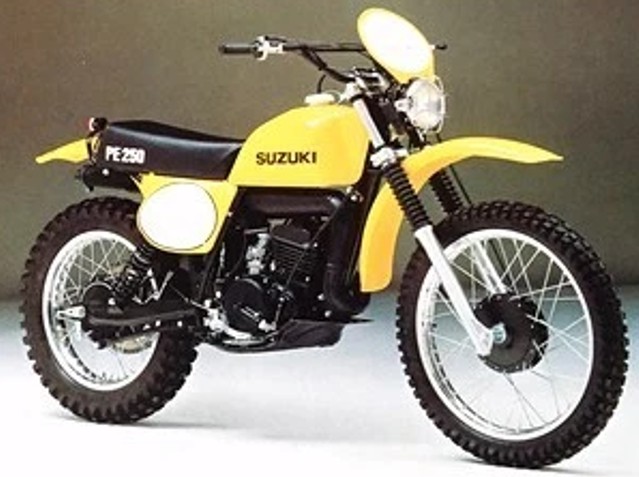
Specifications and workshop reference information for the 1977 Suzuki PE250, including engine, chassis, service data and setup details.
Note: Specs are compiled from factory data, manuals and owner feedback. Bikes vary — if yours is different, jump into the forum and share it.
| Engine Type | Air-cooled 2-stroke single-cylinder piston reed valve |
| Displacement | 246 cc |
| Bore × Stroke | 70.0 × 64.0 mm |
| Compression Ratio | 6.7:1 |
| Maximum Power | 24 hp |
| Maximum Torque | 27 Nm |
| Carburetor | Mikuni VM32SS | Replacement Options |
| Lubrication | Suzuki CCI oil injection |
| Fuel Mix Ratio | |
| Ignition | CDI magneto |
| Spark Plug | NGK B8ES |
| Spark Plug Gap | 0.6 – 0.7 mm |
| Transmission Type | 6-speed manual |
| Clutch | Wet multi-plate |
| Primary Reduction | 3.181 |
| Final Reduction | 3.857 |
| Overall Reduction | 12.27 |
| Overall Length | 2140 mm |
| Overall Width | 880 mm |
| Overall Height | 1190 mm |
| Wheelbase | 1425 mm |
| Ground Clearance | 290 mm |
| Fuel Tank Capacity | 10 L |
| Bearing Sizes | Bearing Finder |
| Frame Type | Steel single cradle |
| Caster Angle | 28° |
| Trail | 115 mm |
| Front Suspension | Telescopic forks | Fork Oil Levels |
| Rear Suspension | Twin shock swingarm |
| Front Suspension Travel | 220 mm |
| Rear Suspension Travel | 110 mm |
| Front Tire | 3.00-21 | Tyre Size Guide |
| Rear Tire | 4.60-18 | Tyre Size Guide |
| Front Brake | Drum brake |
| Rear Brake | Drum brake |
The 1977 Suzuki PE250 arrived at a time when Japanese manufacturers were pushing hard into serious enduro competition. Suzuki already had strong motocross credibility through the RM range, and the PE250 took much of that thinking into a machine built for longer days, rougher terrain and the demands of cross-country riding.
The PE250 was not simply an RM with lights. It was developed around the needs of enduro riders: a broad, usable power delivery, practical gearing, stronger trail manners and enough durability to cope with rocks, roots, creek crossings and hours in the saddle. The 250 cc two-stroke engine gave the bike plenty of punch without becoming too difficult to manage in tight going, which helped make the PE series popular with club riders as well as serious competitors.
For owners today, the engine remains one of the bike’s main attractions. Like any old two-stroke, however, performance depends heavily on condition and setup. Worn crank seals, poor reeds, air leaks or incorrect jetting can turn a strong PE into a frustrating starter. Checking the carburettor and fuel-system setup is worthwhile before chasing more complicated problems, particularly if the bike has been sitting for years or has changed hands several times.
Suspension was advanced for its era but still very different from modern enduro equipment. The PE250 used conventional forks and twin rear shocks, so correct servicing makes a noticeable difference. Old fork oil, tired seals and worn shock bushes can leave the bike harsh at one end and vague at the other. Owners working through the front end can refer to the vintage motorcycle fork oil guide when checking service requirements and suitable oil information.
Final drive condition also deserves attention. Enduro bikes tend to suffer from grit, mud and water contamination, and the PE250 is no exception. A stretched chain or badly worn sprockets can make the transmission feel rough and can accelerate wear elsewhere. Before fitting replacements, inspect chain alignment, sprocket condition and gearing using the chains and sprockets reference as a guide.
Another area worth checking is the air intake system. Vintage enduro bikes often spend years with damaged filter cages, degraded foam or improvised replacement elements. A poor filter can quickly undo an engine rebuild, especially in dusty Australian conditions. The VMXOwners air filter reference is useful when sorting out replacement options.
What makes the 1977 PE250 interesting today is the way it sits between eras. It still has the simplicity and slim feel of a mid-1970s trail bike, but it also shows Suzuki moving toward more specialised enduro design. It was built for riders who wanted competition performance without sacrificing the practicality needed for long events.
For restoration, originality is worth preserving where practical, but reliability should come first. Sound ignition, correct jetting, fresh suspension oil, good bearings and a properly maintained drive system will do more for the riding experience than cosmetic perfection.
Nearly fifty years later, the 1977 PE250 remains a highly usable vintage enduro machine and an important part of Suzuki’s off-road history.
Discuss vintage motocross bikes, restorations, tuning and riding.