
Specifications and workshop reference information for the 1973 Honda XR75, including engine, chassis, service data and setup details.
Note: Specs are compiled from factory data, manuals and owner feedback. Bikes vary — if yours is different, jump into the forum and share it.
| Engine Type | Air-cooled, 4-stroke, single-cylinder, OHC |
| Displacement | 72 cc |
| Bore × Stroke | 47.0 × 41.4 mm |
| Compression Ratio | 8.8:1 |
| Maximum Power | 6 hp |
| Maximum Torque | |
| Carburetor | Keihin | Replacement Options |
| Lubrication | Wet sump |
| Ignition | Flywheel magneto |
| Spark Plug | NGK D8EA |
| Spark Plug Gap | 0.6–0.7 mm |
| Valve Clearance (Intake) | 0.05 mm |
| Valve Clearance (Exhaust) | 0.05 mm |
| Transmission Type | 4-speed manual |
| Clutch | Wet multi-plate |
| Final Reduction | Chain drive |
| Overall Length | 1,560 mm |
| Overall Width | 680 mm |
| Overall Height | 920 mm |
| Wheelbase | 1,040 mm |
| Ground Clearance | 200 mm |
| Fuel Tank Capacity | 4.5 L |
| Bearing Sizes | Bearing Finder |
| Frame Type | Steel backbone frame |
| Front Suspension | Telescopic forks | Fork Oil Levels |
| Rear Suspension | Dual shock swingarm |
| Front Suspension Travel | |
| Rear Suspension Travel |
| Front Tire | 2.50-16 | Tyre Size Guide |
| Rear Tire | 3.00-14 | Tyre Size Guide |
| Front Brake | Drum brake |
| Rear Brake | Drum brake |
The 1973 Honda XR75 occupies a special place in off-road motorcycle history. Small, simple and remarkably tough, it introduced countless young riders to dirt bikes and helped establish the XR name that Honda would carry through decades of successful trail and competition machines.
Introduced for 1973, the XR75 was powered by a compact 72 cc air-cooled four-stroke single-cylinder engine. At a time when two-strokes dominated much of the serious motocross scene, Honda gave younger riders something different. The little four-stroke delivered manageable power, easy starting and the sort of mechanical durability that allowed an XR75 to spend entire weekends being ridden around paddocks, trails and makeshift motocross tracks.
Its four-speed gearbox and conventional chain final drive were uncomplicated, but surviving bikes have often been altered over the past half-century. Different sprockets were commonly fitted to change acceleration or top speed, while chains and sprockets naturally became consumable items. Owners bringing an old XR75 back to life can use the VMXOwners chains and sprockets reference guide when assessing replacement components and gearing.
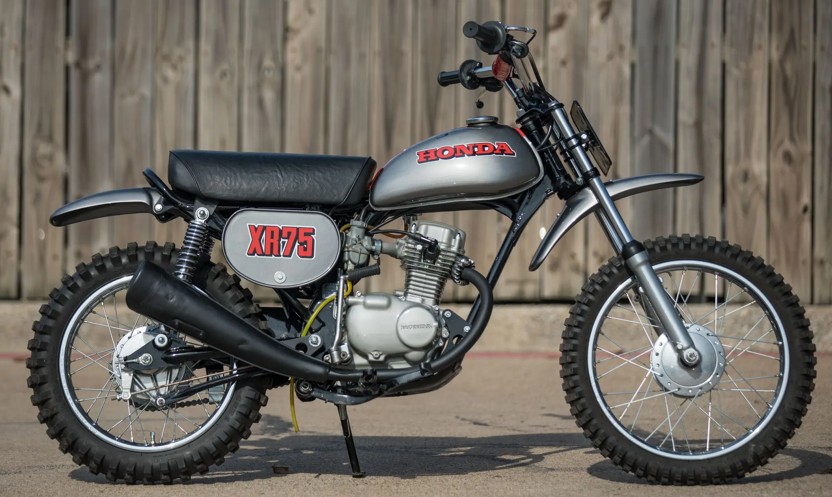
The chassis was equally straightforward. Twin rear shocks, conventional telescopic forks and drum brakes front and rear were typical of the period. Suspension travel seems modest compared with later motocross machinery, but the XR75 was light and unintimidating. For a young rider graduating from minibikes, it looked and felt like a real motorcycle.
That appearance mattered. The 1973 model's slim fuel tank, upswept exhaust, high front guard and purposeful off-road stance gave it the look of Honda's larger dirt bikes. Today, original tanks and bodywork are among the components restorers pay particular attention to, and the VMXOwners vintage motorcycle fuel tank reference can help when investigating repair or replacement options.
Mechanically, an XR75 that has been sitting for years deserves a methodical recommissioning rather than simply fresh fuel and a hopeful kick. Check valve clearances, ignition, compression, fuel system, wheel bearings, steering-head bearings, brakes and cables. The carburettor in particular may have suffered from old fuel, corrosion or decades of previous-owner adjustments. The VMXOwners carburettor reference provides additional information when identifying or sorting older carburettor systems.
Wheel and steering bearings are another area easily forgotten. Fifty years of dirt, water and pressure washing can take their toll even on a bike that otherwise presents well. Before putting a restored machine back into regular use, checking bearing condition with the VMXOwners Bearing Finder is worthwhile.
What makes the 1973 XR75 particularly significant today isn't outright performance. Later XR75s and XR80s became progressively more refined, and modern youth bikes are in another world altogether.
Its importance is what it represented.
For thousands of riders, an XR75 was their first clutch, first gearbox, first trail ride, first crash and probably their first attempt at fixing a motorcycle. Many riders who later moved onto CRs, XRs and full-size motocross bikes started on one of these little Hondas.
More than half a century later, the original 1973 XR75 remains one of those rare motorcycles whose historical importance is far greater than its engine capacity suggests.
Discuss vintage motocross bikes, restorations, tuning and riding.