
Specifications and workshop reference information for the 1980 Kawasaki KLX250, including engine, chassis, service data and setup details.
Note: Specs are compiled from factory data, manuals and owner feedback. Bikes vary — if yours is different, jump into the forum and share it.
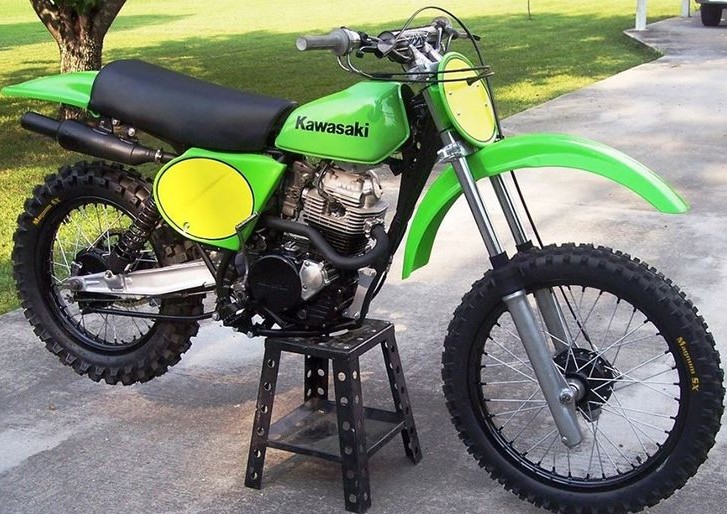
| Manufacturer | Kawasaki |
| Model | KLX250-A2 |
| Year | 1980 |
| Motorcycle Type | Off-road / Enduro |
| Fuel Tank Colour | Lime Green |
| Front Fender Colour | Lime Green |
| Engine Number Range | LX250AE004101 onwards |
| Frame Number Range | LX250A-004101 onwards |
| Engine Type | Air-cooled, 4-stroke, single-cylinder |
| Valve Train | Single overhead camshaft (OHC), 2 valves |
| Displacement | 246 cc |
| Bore x Stroke | 70.0 x 64.0 mm |
| Compression Ratio | 8.9:1 |
| Starting System | Kick starter |
| Carburetor | Single 32 mm Mikuni carburetor | Replacement Options |
| Fuel Capacity | 9.5 litres |
| Spark Plug | NGK B7ES |
| Transmission | 5-speed |
| Shift Pattern | Return shift |
| Final Drive | Chain |
| Drive Chain | 520, 108 links |
| Front Sprocket | 14 teeth |
| Rear Sprocket | 46 teeth |
| Front Suspension | Air-assisted telescopic forks | Fork Oil Levels |
| Rear Suspension | Twin shock absorbers with adjustable spring preload | Rear Suspension Setup |
| Front Brake | Drum |
| Rear Brake | Drum |
| Front Tyre | 3.00-21 | Tyre Size Guide |
| Rear Tyre | 4.00-18 | Tyre Size Guide |
| Wheelbase | 1,420 mm |
| Seat Height | 940 mm |
| Wet Weight | 113 kg |
The 1980 Kawasaki KLX250 arrived at an interesting point in off-road motorcycle history. Two-strokes still dominated motocross and serious competition, but Japanese manufacturers were beginning to explore lighter, more capable four-strokes that could handle everything from trail riding to enduro competition. Kawasaki’s answer was the KLX250, a machine that today has become an appealing and increasingly uncommon vintage off-road bike.
At the heart of the 1980 KLX250 was a 246 cc air-cooled, single-cylinder four-stroke engine. It used a relatively simple overhead-cam design and avoided much of the complexity found on later four-stroke competition motorcycles. Power delivery was broad and manageable rather than explosive, making the KLX well suited to tight trails, slippery climbs and long days in the bush.
Fuel was delivered through a 32 mm Mikuni carburettor. On a surviving KLX250, carburettor condition is particularly important. Worn slides, incorrect jetting, blocked pilot circuits and air leaks can transform an otherwise healthy old four-stroke into a frustrating starter. Returning the intake system and jetting to a known baseline is often one of the best places to begin when recommissioning a bike that has been sitting.
The chassis reflected Kawasaki's attempt to build something considerably more serious than a conventional trail bike. Long-travel telescopic front forks were paired with twin rear shock absorbers, placing the KLX firmly in the transitional period immediately before rising-rate monoshock systems became commonplace. Owners restoring the suspension should pay attention to correct fork oil setup and servicing, as decades-old oil, seals and internal wear can dramatically change how these early long-travel forks behave.
Its twin-shock rear end is also part of what gives the early KLX250 its distinctive vintage character. Correct spring preload, damping and ride height matter more than many owners realise, particularly if the motorcycle is going to be ridden rather than simply displayed. The VMXOwners rear suspension setup guide provides a useful starting point when setting up a restored machine.
Kawasaki kept the rest of the motorcycle appropriately straightforward. Drum brakes were fitted front and rear, while a 21-inch front and 18-inch rear wheel combination gave the KLX the proportions expected of a proper off-road motorcycle. Modern replacement tyres can greatly improve the riding experience, although owners should consider both original sizing and overall tyre diameter when choosing replacements using the vintage motorcycle tyre size guide.
For today's VMX owner, originality can be one of the biggest challenges. Early KLX models were never produced in the numbers of Kawasaki's KX motocross machines, and model-specific tanks, plastics, exhaust components and chassis pieces can be considerably harder to locate.
That scarcity is also part of the attraction. The 1980 KLX250 represents an era when manufacturers were rediscovering what a lightweight four-stroke could do off road. It wasn't designed to overpower the two-strokes of the period. Instead, it offered tractability, simplicity and usable performance in a genuinely capable chassis.
More than four decades later, a properly sorted KLX250 remains exactly what Kawasaki intended: a lightweight, uncomplicated four-stroke that's happiest when it's being ridden through the bush rather than sitting quietly in a shed.
Discuss motocross bikes, restorations, tuning and riding.