
Specifications and workshop reference information for the 1969 BSA B44, including engine, chassis, service data and setup details.
Note: Specs are compiled from factory data, manuals and owner feedback. Bikes vary — if yours is different, jump into the forum and share it.
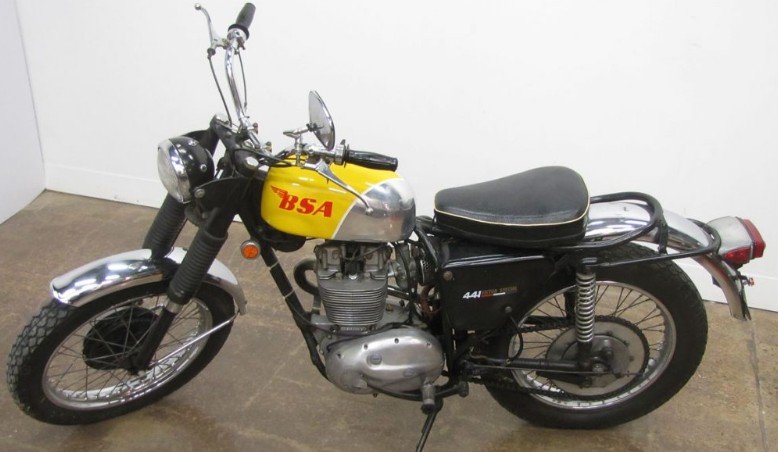
| Manufacturer | BSA |
| Model | B44 |
| Year | 1969 |
| Country of Origin | United Kingdom |
| Engine Capacity | 441 cc |
| Engine Construction | Unit construction |
| Engine Type | Air-cooled single-cylinder four-stroke |
| Valve Train | OHV, 2 valves |
| Bore | 79 mm |
| Stroke | 90 mm |
| Displacement | 441 cc |
| Lubrication | Dry sump |
| Starting System | Kick starter |
| Inlet Tappet Clearance | 0.008 in (0.203 mm) |
| Exhaust Tappet Clearance | 0.010 in (0.254 mm) |
| Carburetor | 30 mm Amal Concentric | Replacement Options |
| Clutch | Wet multi-plate |
| Transmission | 4-speed manual |
| Primary Drive | Chain |
| Final Drive | Chain |
| Frame | Tubular steel cradle frame |
| Front Suspension | Telescopic fork | Fork Oil Levels |
| Rear Suspension | Swingarm with twin shock absorbers | Rear Suspension Setup |
| Front Brake | Drum |
| Rear Brake | Drum |
| Wheel Type | Wire-spoke |
| Tyre Information | Sizes vary by B44 model variant | Tyre Size Guide |
| Ignition | Battery and coil |
| Ignition Timing | 28° BTDC fully advanced |
| Contact Breaker Gap | 0.015 in (0.381 mm) |
| Spark Plug | Champion N4 |
| Spark Plug Gap | 0.020-0.025 in (0.508-0.635 mm) |
The 1969 BSA B44 comes from an era when a big British single was still a serious proposition in off-road competition. Before lightweight European and Japanese two-strokes completely changed motocross, machines derived from motorcycles like the B44 could be found scrambling through mud, climbing hills and competing in everything from club events to long-distance off-road racing.
At the centre of the B44 was a 441 cc air-cooled four-stroke single. Its 79 mm bore and long 90 mm stroke produced the sort of strong, deliberate power delivery that became a trademark of British singles. Rather than relying on high engine speed, the B44 rewarded riders who used its torque, selected the right gear and maintained momentum.
The engine used overhead valves operated by pushrods and was built around BSA's unit-construction layout, combining the engine and four-speed gearbox into a relatively compact package. Lubrication was dry-sump, another traditional British arrangement that owners restoring these machines need to understand and maintain correctly.
Fuel was supplied by an Amal Concentric carburettor, one of the most recognisable carburettors fitted to British motorcycles of the period. After more than half a century, worn slides, damaged jets, incorrect settings and air leaks are common problems. Owners working through these issues can refer to the vintage motorcycle carburettor replacement guide when researching repair and replacement possibilities.
The chassis was equally traditional: a tubular steel frame, telescopic front forks and a swingarm controlled by twin rear shock absorbers. Suspension performance was modest compared with what arrived during the 1970s, but a properly rebuilt B44 can still be surprisingly capable. Fresh fork oil, sound bushes and straight fork tubes are particularly important, and the vintage motorcycle fork oil reference is useful when servicing period front suspension.
At the rear, the B44's twin-shock arrangement provides plenty of scope for improvement while retaining the correct period appearance. Spring rate, preload and damping all affect how these machines behave on rough ground, making the twin-shock rear suspension setup guide relevant for riders preparing a B44 for vintage competition.
Both wheels used traditional drum brakes, while power reached the rear wheel through chain final drive. On any B44 being returned to use, the vintage motorcycle chains and sprockets guide is worth consulting alongside inspection of the gearbox sprocket, rear sprocket and chain alignment.
The B44 name covered several versions, from road-going machines to more competition-oriented models, so identifying exactly which variant survives is important before ordering parts or beginning a factory-correct restoration. Many were also modified during their working lives, particularly machines used in competition.
For today's VMX owner, that history is part of the attraction. A 1969 BSA B44 represents the closing years of an important chapter in off-road motorcycle development: big four-stroke singles, drum brakes, twin shocks and riders using torque and technique rather than suspension travel and explosive horsepower.
It is old-school motocross machinery in the truest sense — simple, mechanical and unmistakably British.
Discuss motocross bikes, restorations, tuning and riding.